Tag: fiber optic cables

  • Fiber Optic Cables – Transmitting Mediums at high speed

    Fiber Optic Cables – Transmitting Mediums at high speed

    Fiber optic cables are cables that are made up of tiny glass or plastic fibers. These fibers are extremely thin, allowing them to transmit data over long distances using light signals. They are commonly used in telecommunications and networking applications because they can transmit data at high speeds and over long distances without any loss of signal strength. This makes them ideal for transmitting large amounts of data, such as video and audio signals, across long distances. Additionally, fiber optic cables are immune to electromagnetic interference, making them more secure and reliable than traditional copper cables.

    The concept of transmitting light through a transparent medium for the purpose of transmitting information was first proposed by Alexander Graham Bell in 1880. However, it was not until the mid-20th century that the technology was developed to create the first practical fiber optic cables. In 1950, Harold Hopkins and Narinder Singh Kapany conducted experiments on glass fibers, and in 1954, John Tyndall demonstrated that light could be transmitted through a thin transparent medium. In the following years, other scientists and engineers continued to work on the development of fiber optic technology, leading to the creation of the first commercial fiber optic cables in the late 1970s.

    Functioning of Fiber Optic Cables
    One or more strands of glass, each barely thicker than a human hair, make up a fiber optic cable. The core, which offers the path for light to travel, is the center of each strand. In order to prevent signal loss and allow light to pass through bends in the cable, the core is covered in a layer of glass known as cladding.
    Single mode and multi-mode optical fiber cables are the two main varieties. Multi-mode optical fiber cables use LEDs as opposed to single-mode fibers, which require incredibly thin glass strands and a laser to produce light.

    Compared to long-distance copper cabling, fiber cables have a number of benefits.
    A larger capacity is supported by fiber optics. A fiber cable can readily transport more network bandwidth than a copper cable of same thickness. Standard fiber cables come in 10 Gbps, 40 Gbps, and 100 Gbps capacities.
    Signal enhancers are not as necessary because light can travel considerably farther along a fiber line without losing strength. Interruption is less likely to occur while using fiber optic cable. Shielding is necessary to safeguard copper network cables from electromagnetic interference. Even while this shielding is beneficial, it is insufficient to stop interference when numerous wires are connected close together. Most of these issues are avoided by the physical characteristics of fiber optic cables.

    When compared to cable internet, how fast is fiber optic internet?

    Fiber optic internet is typically much faster than traditional cable internet connections. The exact speed of a fiber optic internet connection can vary depending on a number of factors, including the technology used and the quality of the connection. In general, however, fiber optic internet connections are capable of speeds of up to 1 gigabit per second (Gbps), which is much faster than the average cable internet connection. This means that you can download large files, stream high-definition video, and perform other bandwidth-intensive tasks without any issues.

    Currently, cable technology can only handle about 1,000 Mbps of bandwidth, whereas fiber optic internet can handle up to 2,000 Mbps. A 2-hour HD movie may be downloaded in around 32 seconds at 1,000 Mbps. A 2-hour HD movie downloads in roughly 17 seconds at 2,000 Mbps.

    Communication is the most important part of our lives these days. Whether it’s mobile phones, emails, etc.,the basic idea is to transfer messages from one point to another at high speed. This transmission of the signal is via multimedia transfer. The medium can be of 2 types:

    photo:Pixabay

    – Cable transmission media
    – Wireless transmission media

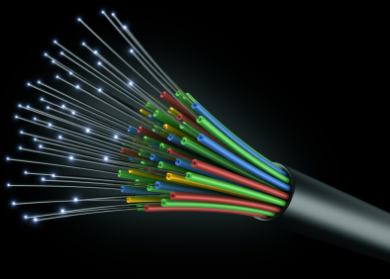
    Among the means of transmission of cables you can choose between twisted cables, copper cables, fiber optic cables and many more. Fiber optic cables are mainly used to carry light. The cable is not a single cable, but it is a collection of individual cables in which each cable is given a plastic coating. The entire cable is also provided with a protective coating depending on the environment in which it will be used. The application environment will determine the robustness, durability and durability of the cable. The material used is mainly plastic or glass depending on the range of transmission. For the short range, plastic is used while for the medium and long range, glass is used.

    The optical system has three components:

    – Optical transmitter
    – Optical receiver
    – Real optical supports that connect the transmitter and receiver

    The optical transmitter can be a LASER, a coherent light source, or a light-emitting diode. The actual propagation of light through the optical fiber is based on Maxwell’s equation. An optical transmitter is a device that converts an electrical signal into an optical signal and transmits it over an optical fiber. It is used in fiber optic communication systems to transmit data over long distances using light as the medium. The optical transmitter typically consists of a light source, such as a laser or an LED, and a modulator that encodes the data onto the light signal. The modulated light is then sent through an optical fiber to the receiver, where it is converted back into an electrical signal. Optical transmitters are used in a wide range of applications, including telecommunications, cable TV, and internet access.

    Fiber optic cables are used for a variety of purposes ranging from long-distance telemetry to transmitting fast information from one node to another within a building. There are many advantages to using fiber optic cables. Some of them are as follows:-

    – Unaffected by electromagnetic interference
    There is no fiber interference or very little. Therefore, data security is maintained
    Multiplexing of a large number of signals is possible, as you can also use high-frequency bandwidths
    Ensuring safety in hazardous areas
    – Much cheaper than other wired media
    There are fewer problems with ground loops in such transmissions.

    Refractive index, material composition, and mode of light transmission are the three criteria used to categorize optical fiber cables.

    OFC’s refractive index has two different forms of basis:

    Step Index Fibers: This type of fiber consists of a core that is enclosed by cladding and has a single, uniform index of refraction.
    Graded Index Fibers: As the radial distance from the fiber axis rises, the refractive index of the optical fiber falls.
    The two forms of OFC are based on the materials:

    Poly(methyl methacrylate) is utilized as the core material in plastic optical fibers, which transmit light.
    Glass Fibers: The glass fibers in this fiber cable are incredibly thin.
    OFC is classified into the following groups according to how light propagates:

    Signals sent over great distances are sent via single-mode fibers.
    Signals are transmitted across short distances using multimode fibers.

    For some specific purposes, the color-coded cable is available. In total, 12 colors are used in cable markings. Each color has its own specific notes to the technicians who manage them. This method facilitates the use of these cables and prevents misadventures.

    Today, hybrid cables are also used, which are a mixture of fiber optic cables and electrical cables. In these hybrid cables, information and power are transmitted together.

    Fiber optic cables are the perfect choice if performance and safety are needed. It’s one of the important things to remember.

  • Numerous benefits of using fiber optic cables

    Numerous benefits of using fiber optic cables

    Communication is the most essential aspect of our lives these days. Be it mobile phones, emails, and so on., the primary idea is to transfer messages from one point to another at superb speeds. This transmitting of signals is performed through transferring mediums. The medium can be of 2 models:-

    ” cable ” transmission mediums
    Wireless transmission mediumsFiber Optic Cables

    Among the cable transmission mediums one can choose from twisted wires, copper wires, fiber optic cables and several more. Fiber optic cables are mainly used to carry light. The cable is not a single wire, but on the other hand is a set of individual wires where every single wire is given a plastic-type coating. The whole cable is also given a protective covering according to the natural environment where it will be used. The environment of app will determine the strength, resistibility and flexibility of the wire. The material used is generally plastic or glass, depending on the variety of transmission. For shorter range, plastic is used whereas for medium and very long range, glass is used.

    The optical system has three parts:

    Optical transmitter
    Optical receiver
    Actual optic medium linking the transmitter and the receiver

    The optical transmission device may be a laser, coherent light source or a light emitting diode. The real distribution of light thru the optical fiber is based on Maxwell’s formula.

    Fiber optic cables are applied for various purposes which range from long distance tele-metering to fast information transmission from one node to some other within a building. There are numerous benefits of using fiber optic cables. Several of them are as follows:

    Not influenced by electro-magnetic disturbance
    There is no or quite little fiber crosstalk. Therefore data protection is maintained
    Multi-plexing of significant number of signals is possible as high frequency bandwidths may also be used
    Offer basic safety in hazardous areas
    Much more practical as compared to other wired mediums
    Much less ground loop issues are present in this kind of transmissions.

    For some particular purposes, color coded cable are accessible. In total TWELVE colors are used in the cable markings. Every single color has its own specifications known to the professionals handling all of them. This technique makes it easier to use such cables and prevents problems.

    These days hybrid cables are also used which are a combine of fiber optic cables and electrical wires. In these types of mixed cables, information and power are transmitted together.

    Fiber optic cables are the best option, if performance and safety are recommended.It is one of the crucial points to keep in mind.

    photo:linkedin