Tag: smartwatch

  • Run further with Forerunner 70 and Forerunner 170 from Garmin

    Run further with Forerunner 70 and Forerunner 170 from Garmin

    Garmin is helping runners take their training one step further with the introduction of Forerunner® 70 and Forerunner 170. These purpose-built running smartwatches are easy-to-use and loaded with features to kick-start a running journey or help dial in training. Both models boast vibrant 1.2-inch AMOLED displays, responsive touchscreens and a traditional 5-button design for extra ease of use. And runners can access everyday health features, advanced training tools, smart notifications and more—all without having to recharge their watch every night.

    “Purposefully designed with everything a runner needs to start their running journey, Forerunner 70 and Forerunner 170 include premium running and training features pulled in from our more advanced Forerunners, plus popular health and wellness metrics. No matter the goal, these smartwatches are the perfect tools to help new and aspiring runners alike make every step count.”
    —Susan Lyman, 
    Garmin Vice President of Consumer Sales and Marketing

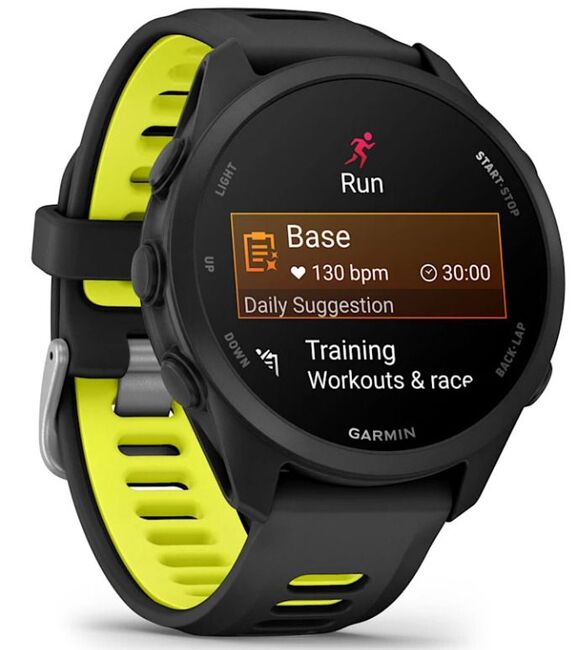
    Garmin Forerunner 70

    Loaded with features for runners of all levels, Forerunner 70 is ready for every step of the journey.

    • Train with the essentials, including built-in GPS, time, distance, pace and wrist-based heart rate.
    • New quick workouts simplify training by creating workout suggestions tailored to a runner’s fitness level and require minimal input to set up: just desired time and intensity level.

      Garmin Forerunner 70
      Garmin Forerunner 70
    • Train for an event, achieve a milestone or improve fitness with Garmin Coach training plans that adapt daily based on health and recovery metrics. In addition to popular plans for more intense training, Garmin Run Coach provides new plans with run/walk workouts and lower volume training.
    • Receive daily suggested workouts – including new run/walk workouts – that adapt after every run to match performance and recovery.
    • Dial in with advanced training features powered by the Garmin Human Performance Lab, including training readiness, training status, wrist-based running power and running dynamics. And tap into more than 80 built-in sports apps, including swimming, cycling, strength training and more to stay active in different ways.
    • Monitor overall health and wellness 24/7 with advanced sleep tracking, sleep coach, breathing variations, heart rate variability (HRV) status, Pulse Ox, lifestyle logging and Health Status.
    • Stay connected with smart notifications, safety and tracking features, LiveTrack and more.

    Forerunner 70 features up to 13 days of battery life in smartwatch mode and is offered in fun and popular colors like citron, soft pink, tidal blue, cool lavender, black and whitestone.

    Garmin Forerunner 170

    Building upon Forerunner 70, Forerunner 170 adds on-the-go features like Garmin Pay contactless payments so runners can stop for a mid-run snack or water bottle and quickly pay from their wrist (with a supported bank and payment network). And for those who like to energize their runs by listening to their favorite playlists, Forerunner 170 Music lets users download songs, podcasts and more from popular third-party music services (subscription required) right to their watch to listen phone-free with wireless headphones.

    Forerunner® 170
    Forerunner® 170 – images: Garmin

    Both Forerunner 170 and Forerunner 170 Music get up to 10 days of battery life in smartwatch mode and are offered in black with a black/amp yellow band and whitestone with a whitestone/cloud blue band. Forerunner 170 Music also comes in vibrant colors like teal green with a teal green/citron band and red pink with a red pink/mango band.

    Available to purchase on garmin.com starting May 15, 2026, Forerunner 70 has a suggested retail price of $249.99, Forerunner 170 is $299.99 and Forerunner 170 Music is $349.99.

  • Security of Smartwatches: Is it possible to hack them?

    Security of Smartwatches: Is it possible to hack them?

    Many people take measures to safeguard their computers against cybercriminals, yet they often overlook the fact that their phones and smartwatches are also vulnerable. Although smartwatches may seem like mere accessories to our primary devices, they can still be exploited by malicious individuals. Consequently, it is crucial to understand the ease with which smartwatches can be hacked and to adopt protective measures.

    Smartwatches have the capacity to store a wide range of data, including highly sensitive information such as phone numbers, email addresses, login credentials, and payment details. If hackers successfully gain access to this information, they can cause significant harm. While the amount of data stored on a smartwatch might not be as substantial as that on a computer or smartphone, it does not imply that there is nothing of value for malicious actors to pursue. Even a single phone number or a set of credentials can expose individuals to various risks. Therefore, it is unwise to assume that your smartwatch, despite being a seemingly inconsequential accessory, is immune to hacking attempts.

    Smartwatches are typically connected to smartphones, establishing a direct link that renders them susceptible to hacking. Cybercriminals can intercept the information exchanged between smartphones and smartwatches, illustrating why smartwatches are an enticing target for malicious activities. It is essential to recognize this inherent risk and take appropriate precautions to safeguard your smartwatch and the data it contains.

    Samsung Galaxy Watch 5 Pro
    Samsung Galaxy Watch 5 Pro – photo Samsung

    Smartwatches can be regarded as miniature computers, offering a multitude of functionalities such as internet connectivity, Bluetooth, NFC, call-making capabilities, and text messaging. Consequently, they support various wireless communication channels, which makes them susceptible to remote attacks.

    The range of remote attack possibilities is extensive, making it impractical to list them all comprehensively. However, there are specific types of attacks that smartwatches are particularly vulnerable to.

    Phishing attacks exploit various communication channels, including email, SMS, and social media direct messages. These attacks involve impersonating legitimate individuals or organizations to distribute malware or steal data. If you receive a phishing email and open it on your smartwatch, you expose yourself to risk.

    For instance, let’s consider a scenario where you unintentionally open a phishing email attachment on your smartwatch, unknowingly installing malware on the device. Once activated, this malware can record your activities, steal data, and even track your location. Smartwatches have even fallen victim to highly dangerous forms of malware like ransomware, with email phishing being used as a means to deploy such malicious programs.

    Moreover, using Bluetooth on a smartwatch can pose risks. Bluetooth is a short-range wireless technology commonly employed to pair devices like wireless headphones and speakers. In the case of smartwatches, Bluetooth enables connectivity with your smartphone, facilitating call management, app usage, and access to additional features.

    However, the utilization of Bluetooth to establish a connection between your smartphone and smartwatch opens up another avenue for hackers to exploit. Cybercriminals can compromise the Bluetooth connection and eavesdrop on the data transmitted between the two devices.

    Another vulnerability arises from the usage of default passwords on smartwatches. Default passwords are often assigned to Internet of Things (IoT) devices during the manufacturing process. If cybercriminals manage to discover your original default password, they can gain unauthorized access to your smartwatch through the device’s backend. Although it is possible to change this password, doing so is often challenging, and many users neglect this task, leaving an exploitable channel for hackers.

    It is crucial to be aware of these vulnerabilities and take appropriate precautions to protect your smartwatch from remote attacks.

    Ensuring the security of your smartwatch against hackers involves implementing several measures. Here are some steps you can take to keep your smartwatch safe:

    • Manage Connections: Smartwatches utilize various communication channels like WiFi, Bluetooth, and NFC. To minimize the risk of exploitation, enable only the connections you currently need. For instance, if you don’t require NFC on a particular day, disable it until it’s needed again. Additionally, avoid connecting your smartwatch to too many devices simultaneously, as a compromise in one device can lead to access to your smartwatch.
    • Public WiFi Awareness: Connecting your smartwatch to public WiFi networks can make you an easy target for hackers. This applies to all devices, including laptops, tablets, and smartphones. To mitigate the risks of data theft or tracking by cybercriminals, it’s crucial to use protective protocols like a Virtual Private Network (VPN) when connecting to public WiFi networks.
    • Software Updates: Regularly updating your smartwatch’s software, particularly the operating system, is vital for enhancing security. Software updates often include bug fixes and patches that address vulnerabilities, reducing potential security risks. Although waiting for updates to complete can be inconvenient, it is important to install them as frequently as possible.
    • Strong Password Protection: Physically safeguard your smartwatch by employing a strong password. In cases where someone gains physical access to your smartwatch, the installation of malware becomes a possibility. A robust password serves as an additional layer of defense against unauthorized access.
    • Choose Trusted Manufacturers: Opt for smartwatches from reputable and trusted manufacturers. This ensures that your device is equipped with robust security measures. Cheaper smartphone brands may compromise certain features, including security protocols, in order to offer lower-priced devices. While this is not always the case, selecting a brand with a good reputation and positive reviews generally provides greater security assurance.

    By following these measures, you can significantly enhance the security of your smartwatch and reduce the risk of unauthorized access or compromise by hackers.
