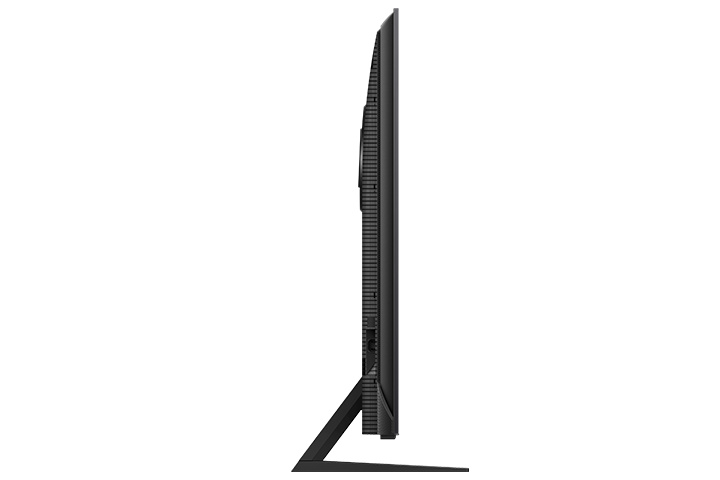
The TCL QM7 sports a sleek, modern design that balances aesthetics with functionality. Available in five sizes—55, 65, 75, 85, and 98 inches—it caters to various room sizes and budgets. The 65-inch model, a popular choice, measures 56.9 x 32.9 x 2.8 inches (without stand) and weighs approximately 45.9 pounds, making it sturdy but manageable with two people for setup. The 98-inch version swaps the central pedestal stand for dual feet to support its massive size, which may impact placement options.
The TV features slim chrome bezels and a brushed-metal strip around the edges, giving it a premium look that belies its price point. This design choice may pose challenges for placing a soundbar directly in front, especially on smaller media consoles. The rear panel has a checkered pattern with a centrally mounted Onkyo subwoofer, contributing to its 2.1 audio system. Cable management is facilitated by a removable plate on the stand, allowing tidy routing of HDMI and power cables.
- Sleek, modern design with slim bezels
- Sturdy central stand (except 98-inch model)
- Comprehensive port selection with dedicated eARC
- Effective cable management
- Pedestal stand may obstruct soundbar placement
- Remote feels clunky and less refined
- 98-inch dual-foot stand limits placement flexibility
The QM7 excels in bright environments, with real-world brightness exceeding 1,500 nits in HDR content, making it ideal for sunlit rooms. Its mini-LED backlight provides precise control, minimizing blooming around bright objects against dark backgrounds, though some blooming is noticeable compared to premium models like the TCL QM8 or Hisense U8N. Black levels are deep for a QLED, but not as inky as OLEDs, and shadow detail is excellent, particularly in Dolby Vision mode.
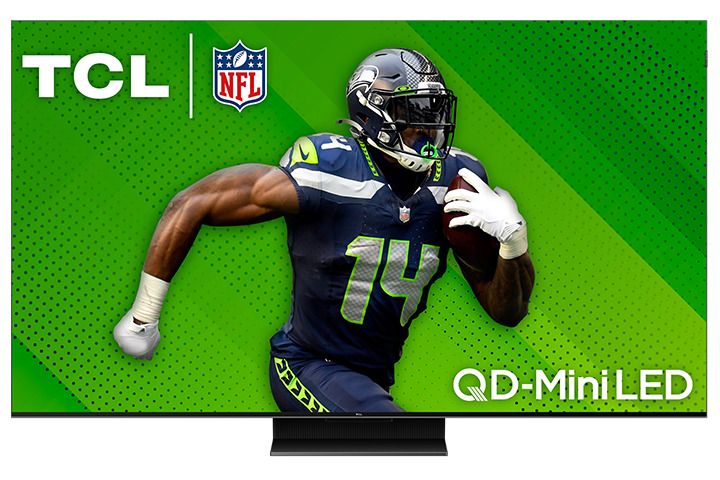
In testing, the QM7 handles high-APL (average picture level) scenes, like bright beach shots, with strong highlight detail, though luminance drops slightly when the entire screen is lit. For darker rooms, its contrast and local dimming enhance immersion, as seen in films like Star Wars: Ahsoka, where starry skies pop against deep blacks. However, a firmware bug tying SDR and HDR brightness settings has been reported, requiring manual adjustments or a power cycle to resolve, though TCL has issued fixes for some units.
The QM7’s quantum dot layer ensures vivid, mostly natural-looking colors with a wide gamut, covering most HDR formats (Dolby Vision, HDR10, HDR10+, HLG). Colors pop in vibrant content like Deadpool & Wolverine, but pre-calibration HDR accuracy is subpar, with slight over-brightening of blacks and midtones. Calibration can improve accuracy, though most users won’t notice without a side-by-side comparison. Gradient handling shows minor banding in grays but is smooth across other colors.
The QM7’s AIPQ PRO processor handles low-resolution content well, smoothing artifacts in low-bitrate streams and upscaling DVDs or 1080p content with minimal loss of detail. However, fine text or intricate patterns may appear less sharp. Motion performance is solid, with minimal stutter in fast-paced scenes, though those sensitive to judder may notice it in 24fps content.
- High brightness (1,500+ nits) for bright rooms
- Vibrant, mostly accurate colors with quantum dots
- Deep blacks and minimal blooming for a QLED
- Strong upscaling and motion handling
- Supports all major HDR formats
- Mediocre off-axis viewing angles
- Subpar pre-calibration HDR accuracy
- Occasional blooming in high-contrast scenes
- Firmware bug affecting SDR/HDR settings
- Minor banding in gray gradients
The QM7’s 2.1 Onkyo audio system, featuring a rear-mounted subwoofer, delivers surprisingly robust sound for a flatscreen TV. With 50W of power (40W for the QM7K), it produces clear mids and highs, filling small to medium-sized rooms effectively. Dialogue is crisp, and the system supports Dolby and DTS advanced audio formats via eARC, ensuring compatibility with external soundbars or receivers.
However, the subwoofer’s bass output is underwhelming, lacking the depth needed for cinematic explosions or music-heavy content. While adequate for casual viewing, audiophiles or home theater enthusiasts will likely pair the QM7 with a soundbar or surround system for a fuller experience. User reviews praise the built-in audio for its clarity but often recommend external audio for larger rooms or immersive setups.
- Clear mids and highs for dialogue
- Decent volume for small/medium rooms
- Supports Dolby/DTS audio formats
- eARC port preserves HDMI 2.1 inputs
- Weak bass from subwoofer
Not ideal for large rooms without external audio

TCL QM7 – images: TCL
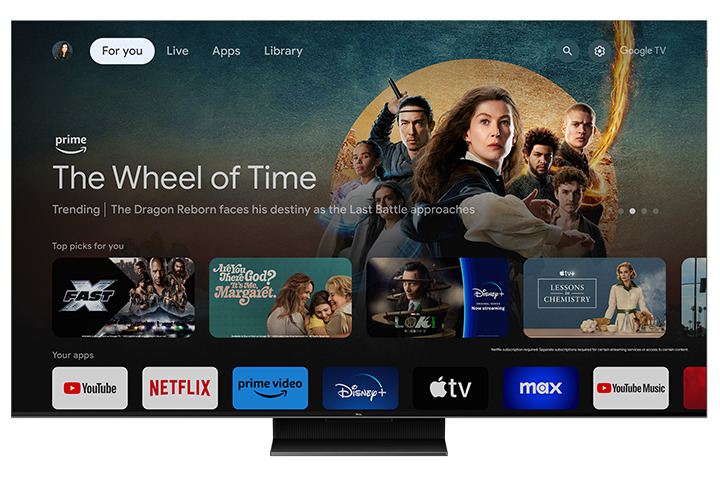
The QM7 runs Google TV (version 12 on the QM7K), offering a snappy, intuitive interface with access to major streaming apps (Netflix, Prime Video, YouTube, Disney+, etc.). The platform supports Google Cast and Apple AirPlay for seamless streaming from mobile devices. Hands-free voice control via Google Assistant, plus compatibility with Alexa and Apple HomeKit, adds versatility for smart home integration.
- Fast, intuitive Google TV interface
- Broad app support and casting options
- Hands-free voice control with Google Assistant
- Smart home compatibility (Alexa, HomeKit)
- Occasional software glitches
- Google TV less preferred by some vs. Roku
The QM7 is a gamer’s delight, earning praise as one of the best gaming TVs in its price range. Its two HDMI 2.1 ports support 4K at 120Hz and 144Hz, plus 1080p at 240Hz (288Hz on QM7K), catering to consoles (PS5, Xbox Series X) and high-end PCs. Variable Refresh Rate (VRR) with AMD FreeSync Premium Pro ensures tear-free gameplay, while Auto Low Latency Mode (ALLM) minimizes input lag.
- Low input lag (8.1ms at 120Hz)
- HDMI 2.1 with 4K/144Hz and VRR
- Game Master overlay for quick settings
- AMD FreeSync Premium Pro support
- Viewing angle limits multiplayer setups
- Occasional input lag bug requiring power cycle
- Not all HDMI ports are 2.1
The QM7’s combination of mini-LED brightness, gaming features, and HDR support rivals more expensive TVs, but its viewing angles, HDR accuracy, and software quirks prevent it from matching premium models like the TCL QM8 or Sony BRAVIA 7. For budget-conscious buyers prioritizing picture quality and gaming, the QM7 is hard to beat, especially on sale.
- Exceptional value, especially on sale
- Premium features at mid-range price
- Competitive with pricier QLEDs
- Loses to premium models in accuracy and viewing angles
- Hisense U7N offers similar performance for less
- High customer satisfaction for price
- Vibrant, bright picture widely praised
- Easy setup and intuitive interface
- Occasional reports of dead pixels
- Glossy screen prone to reflections
- Unproven long-term reliability
