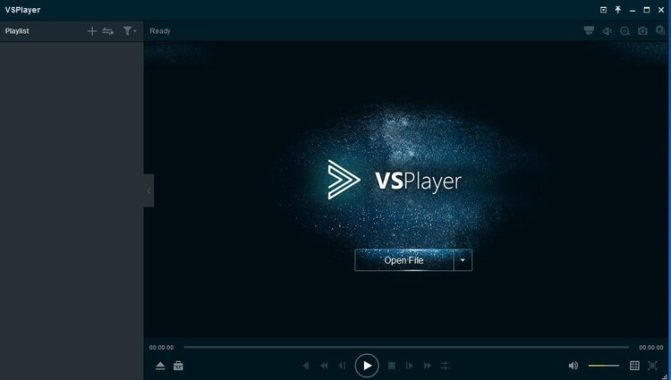
Using VSPlayer as a multimedia player, you may view live RTSP streams, playback and edit recorded files, use the continuous capture mode, apply expansion models, and so much more.
One of the initial things you’ll need to make sure you have is a great multimedia player when you want to enjoy multimedia stuff on your computer. These days, they come in a variety of sizes and styles and each one offers something distinctive or different. Additionally, since everyone has various wants, it’s essential that you select the best solution for them.
With VSPlayer, you’ll be able to see live streams, edit and play recorded files on your computer, play multiple files, and use a variety of editing tools to let you add a new level of enjoyment. Additionally, you can convert several formats into the forms you want. It is employed in a way that requires little effort from you.
VSPlayer – multimedia player
Simple to Set Up and Use VSPlayer can be easily and quickly installed. It will be simple for you to install it if you just follow the simple instructions in the installation panel.
You won’t need to go through a configuration process, so you can utilize the application straight away. Of course, you can set it up exactly how you want it before using it.
Play recordings, edit them, and do even more with VSPlayer Your computer’s recorded files can be played and edited with the assistance of this program.
It’s a complete tool that may meet your needs as a player and an editor. It is also helpful for viewing RTSP live streams, which are popular enough that many users will wish to use them. By selecting the plus button, you can add new content to the interface and freely select the type of content you want to add. However, some users may find the fact that you may only load MP4 or 246 files into the interface to be a minor inconvenience. Watching live streams and modifying recorded files are both possible with VSPlayer.
How to easy install Safari on Linux? When comparing the main online browsers, Apple’s Safari probably includes capabilities that suit your needs. Nevertheless, despite its popularity, Safari has never been formally published for Linux, which is peculiar given that UNIX is a shared technology between Linux and macOS.
The best part is that there are various ways to run Safari on Linux whether you’re a Linux user or web developer who has to offer support for the Safari browser. Despite having these limitations, Safari 5 still includes all the features you require for web browsing. WINE is used to install Safari on Linux. To install Safari on Linux, there are two potential workarounds: Use WINE by itself or in conjunction with PlayOnLinux to give WINE with a graphical user interface (UI).
After completing this guide, you will also have simple access to other applications that are not currently operating on Linux because you may install a variety of additional Windows programs using WINE and PlayOnLinux in addition to Safari.
photo: Pixabay
How to set up WINE One of the most well-known Linux packages is WINE, which can be found in the majority of package managers and software stores. Using the following command (for 32-bit PCs), you can install WINE in Ubuntu (or an Ubuntu-based distribution):
wine32 sudo apt install or (on 64-bit systems):
wine64 – sudo apt install One thing to keep in mind is that Ubuntu’s WINE version is fairly ancient. Do the following if you want the most recent stable version of WINE:
deb https://dl.winehq.org/wine-builds/ubuntu/eoan main, sudo apt-add-repository
The command listed above is for Ubuntu 19.10 (eoan). Change the name to reflect the Ubuntu version you are using (such as “bionic,” “xenial,” etc.)
System upgrades
apt update 4 with sudo. Install WINE’s stable version lastly.
Installing WineHQ-Stable with sudo apt install —install-recommends Now WINE is set up.
Installing WINE and Safari Open a Terminal window and enter the following commands before downloading Safari:
cd to “/build/safari” and type “mkdir -p”
You can now use the wget command to download Safari:
wget SafariSetup.exe at http://appldnld.apple.com/Safari5/041-5487.20120509.INU8B When the download is finished, use the following command to start Safari Setup:
SafariSetup.exe for wine You could be asked to download some more software at this point, such Mono or Gecko. Click Install when requested, then watch as the packages download.
Safari Installer will start up immediately after you have all the required software.
The Safari Installer will start up immediately. The web browser will be installed after you have finished the required steps, and you can begin using Safari on Linux. Using PlayOnLinux, install Safari Since WINE does not have the best user interface, you might want to install PlayOnLinux instead, which offers a graphical user interface for the most fundamental WINE code.
You can use the following command to install PlayOnLinux:
install playonlinux with sudo PlayOnLinux is now accessible from the Applications menu.
Select Install a software from the PlayOnLinux window. Choose Install a program In the search box, type Safari. In the search box, type “Safari” Select the web browser when it displays, then click Install. Read the Disclaimer section, and then click Next if you agree (2 times). Your pc will now download Safari.
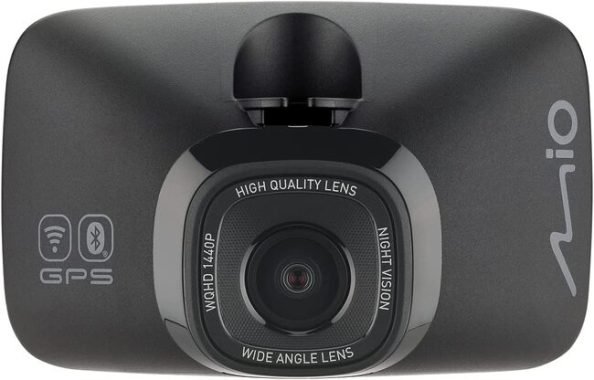
The Mio MiVue 818 dash cam is one of the several versions that this manufacturer offers. The MiVue 818 is a bit of an odd shape, especially when compared to certain skinny and slimline competitors mentioned in our review of the best dash cams, but Mio has the format about right.
It actually has a somewhat massive casing, which is probably there to contain all of the concealed technical gadgets. Once it is mounted to your dash, this form factor is actually extremely comfortable. The bracket that comes with the standard sticky pad is used for this, and if you don’t get it correctly the first time, it can be quite difficult to relocate it again. The Mio MiVue 818 dash cam definitely makes an impression when it comes to video quality. A wide-angle 140-degree lens was used to shoot 2K 1440p video. This implies that the final footage has a ton of detail. Full HD 1080P video at 60 frames per second produces results that are sharp, clear, and stone solid too because to the sturdy mounting method.
Mio MiVue 818 dash cam
The f/1.8 aperture also performs well in difficult lighting situations and at dusk for identifying license plates. A built-in mic and speaker system take care of the audio aspect of things if necessary, while the 2.7-inch display provides a reliable preview of events. The Mio MiVue comes with almost everything you require for high-quality dash cam recording, and it does it at a fairly affordable price.
You may add specific data detail to your footage using Wi-Fi, Bluetooth, and the hugely important GPS, giving you a thorough picture of any events that need to be recorded. A long power cord is also included, and it fits into your 12V charging outlet. It’s unfortunate that there isn’t a microSD card, which might be annoying if you need to get setup and don’t have a replacement part. However, once that is inserted into the camera’s side, you may begin the simple setup procedure. This is surprisingly easy, though you may need to make a few minor tweaks if you want the display to show in another language or switch some measurements of speed from kilometers per hour to miles per hour or vice versa. Your quick-start guide is provided on a glossy fold-out sheet, but there isn’t much information to process. Although you may record directly to the card, Mio does have a companion app if you wish to share or redistribute videos. Be sure to remove whatever you need to before it gets overwritten because this recording procedure is standard practice and operates on a loop. As expected, the Mio MiVue 818 dash cam offers additional functions if the application is downloaded to your smartphone and the Wi-Fi settings are set. This makes it possible to easily perform a backup and receive over-the-air updates, which is helpful for keeping your device updated.Additionally, there are helpful features that make life simpler, such as the self-explanatory “Average Speedcam Alert.” Another neat little feature is that if you park up and still have your lights on, the Mio MiVue 818 will politely ask you to turn them off. More significantly, there are some incredibly helpful features, such a smart parking mode that uses built-in sensors to find motion close to your car’s front. This is made possible by the camera’s three-axis G-sensor, which excels at spotting unusual activity.
Mio has done a great job for the pricing range by covering everything off with a variety of Advanced Driver Assistance Systems (ADAS). Lane Departure Warning, Forward Collision Warning System, Cruise Control Reminder, Fatigue Alert, and HUD Display Mode are a few examples of these. Not to mention those reminders to turn on your headlights. With an Eco drive indicator that indicates when you’re driving most economically, the camera may also help you preserve the environment. Video image quality is excellent. GPS and WiFi. The average speedcam helper is absolutely amazing.
MiVue Pro App: When an incident occurs, the dash cam will instantly store the video to the event folder and stream it live over WiFi to the MiVue Pro app. The WIFI video backup function use point-to-point transmission technology, so it won’t use up your 3G or 4G data. Without taking out the memory card, use your smartphone to download and update the firmware, speed camera data, and voice variants. Video: YouTube/Mio Europe Before installation, click “Live View” to set the camera’s horizontal level. Videos will be arranged according to type and date (Normal, Event or Parking mode folders). If a twin cam is installed, the front and back footage will be synced up to the MiVue Pro app.
The Mio MiVue 818 is a great new dash cam choice, despite the lack of a microSD card to get you started. The oval shaped form fits a lot of technology within, and an adequate app completes the package. Additionally, the Mio MiVue 818’s video recording has generally great image quality and the extra advantage of night vision improvement. Mio MiVue 818 dash cam price: €159.99
Mio MiVue 818 dash cam specs:
Display Size
2.7″
Video
Recording resolution
WQHD 2K 1440P / 30fps Full HD 1080P / 60fps Full HD 1080P / 30fps
The HPE ProLiant RL300 Gen11 is a rack-mountable server designed for small and medium-sized businesses. It is part of HPE’s ProLiant family of servers, which are known for their reliability, performance, and expandability.
The RL300 Gen11 is powered by Intel Xeon Scalable processors and can be configured with up to 3 TB of DDR4 memory. It offers a range of storage options, including support for SATA, SAS, and NVMe drives, as well as a variety of connectivity options, including Gigabit Ethernet, Fibre Channel, and InfiniBand.
The RL300 Gen11 also comes with a number of advanced features to help improve performance and reliability. These include HPE’s Intelligent System Tuning, which automatically adjusts system settings for optimal performance, and HPE’s Integrated Lights-Out (iLO) technology, which allows users to remotely manage and troubleshoot the server.
Overall, the HPE ProLiant RL300 Gen11 is a versatile and powerful server that is well-suited for a wide range of small and medium-sized businesses.
With the new HPE ProLiant RL300 Gen11 servers, businesses would have simple-to-use, trustable, and optimized computing resources that would fit a range of modern workloads, including artificial intelligence (AI), analytics, cloud-native applications, graphically demanding applications, machine learning (ML), virtualization, and remote desktop infrastructure (VDI).
These days, as businesses manage more demanding workloads like AI, machine learning, and graphics projects, they need optimized computing and improved compute performance. The next-generation HPE ProLiant Gen11 servers are created to provide superior efficiency on an organization’s most data-intensive workloads. They support a wide range of architectures, including 4th Generation AMD EPYC processors, 4th generation Intel Xeon Scalable processors, as well as Ampere Altra and Ampere Altra Max Cloud Native Processors. The new HPE ProLiant RL300 Gen11 servers, according to HPE, have three advantages over the previous generation: 33% more high-performance GPU density per server to support AI and graphically demanding workloads, 50% more cores per CPU for greater workload consolidation, and twice as much I/O capacity. With the HPE Silicon Root of Trust, starting at the silicon level, HPE would supply highly secure infrastructure, from the edge to the cloud. With a digital fingerprint unique to the server, the HPE Silicon Root of Trust security technology guards millions of lines of firmware code against malware and ransomware. The HPE Silicon Root of Trust now provides protection for millions of HPE servers throughout the world.
The following new security features would be added to the subsequent-generation HPE ProLiant servers to further improve systems and data security:
Using iLO6, the most recent version of the HPE Integrated Lights-Out, to ensure verification and authentication for device components (iLO). ILO, a remote server management solution, enables clients to set up, monitor, and upgrade HPE servers in a secure manner. The Security Protocol and Data Model (SPDM), a critical security element in servers for authenticating and securely monitoring devices using an open standards-based methodology, is used to enable new authentication in the most recent version. Prevent changes to unique server identity access, including the automatic integration of platform certifications and Secure Device Identity (iDevID). Use a the Trusted Platform Module to monitor a secure boot and system status to offer an additional degree of authentication. Utilize the HPE Trusted Supply Chain to adopt the greatest level of security. The HPE Trusted Supply Chain encourages end-to-end security by using certified servers that would provide improved data security during the manufacturing process. HPE recently increased its capacity to produce and supply globally certified servers from US-based OEMs. Businesses might also acquire HPE’s next-generation computing infrastructure altogether or utilize its pay-as-you-go HPE GreenLake service to transition from one generation to the next. HPE GreenLake is a platform that businesses may use to accelerate data-first modernization. It offers more than 70 cloud services. These services can be used internally, externally, in a colocation facility, or in a public cloud.
Through HPE Financial Services, HPE’s clients can also turn their current technology assets into cash to purchase new or updated technology. By using HPE Pointnext Services, a global team of over 15,000 professionals, customers adopting HPE ProLiant RL300 Gen11 servers may take use of in-depth global expertise to deploy next-generation HPE ProLiant servers and build new experiences, obtain real-time insights from their data, and modernize IT to unlock value.
Availability Servers HPE ProLiant Gen11 The HPE GreenLake cloud platform will start selling HPE ProLiant Gen11 servers with AMD EPYCTM 4th Generation CPUs on November 10, 2022. Orders for the HPE ProLiant RL300 Gen11 servers powered by Ampere can be placed right now from anywhere in the world.
Any HPE ProLiant server can be purchased by customers from HPE or one of its channel partners.
About main benefits of using mp3DirectCut audio editor
mp3DirectCut is a free, lightweight audio editor for MP3 files that allows you to cut, copy, and paste sections of an MP3 file without having to decode and re-encode the file. This makes it faster and more efficient than other audio editors that require decoding and re-encoding, which can introduce additional quality loss.
Some benefits of using mp3DirectCut include:
Fast and efficient editing: Because mp3DirectCut does not need to decode and re-encode the file, it can make edits to an MP3 file quickly and without introducing additional quality loss.
Small file size: mp3DirectCut is a small, lightweight program that does not require a lot of system resources to run, making it ideal for use on older or lower-powered computers.
Easy to use: mp3DirectCut has a simple, intuitive interface that makes it easy to navigate and use, even for users with little to no experience with audio editing.
Wide range of editing features: In addition to basic cut, copy, and paste functions, mp3DirectCut also includes features such as fade in/out, normalize, and volume change, which can be useful for making fine-tuned adjustments to your audio.
Free: mp3DirectCut is free to download and use, making it a great option for users on a budget.
Do a few compressed MP3 files need to be edited? To carry out a few simple and direct actions on your audio tracks, you don’t need complicated and resource-intensive software like Audacity, WavePad, or FL Studio. MP3DirectCut software is all you really need, whether you need to remove a few pieces from your MP3 or split a lengthy file into several shorter recordings.
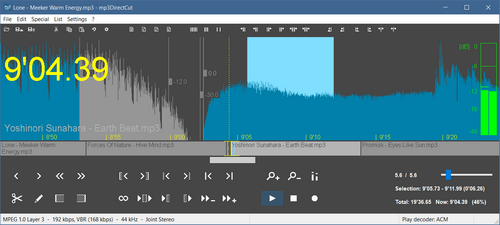
MP3DirectCut software managed to work wonderfully during our tests. Here are some of its most helpful characteristics. The capability of the program to do non-destructive adjustments may be its most crucial feature. The audio track is loaded, but the original file is not saved . Your MP3s can be exposed to a variety of significant operations, including volume adjustment, fading, copying, pasting, and normalization. To execute the audio editing, the files do not need to be decompressed.
MP3DirectCut software
Batch processing is possible with this program. In other words, if you need to modify a few dozen MP3 files, you don’t have to spend time doing the identical operations on every MP3 file.
Simply indicate what needs to be done, pick all MP3s, and let the software handle the batch processing for you. The MP3DirectCut program comes with a decent audio recorder (ACM and Lame encoder) that can record audio directly into an MP3 file using input from your microphone. Support for AAC is also offered. Using the ID3v1.1 Tag Editor, you can change the tags on your audio tracks. Additionally, you may see your audio tracks’ bit rates and cue them automatically, divide them by time values. Long audio tracks can have pauses that the software can automatically identify and use to break the track into many MP3 files. The smaller, resultant tracks are given names and tagged automatically. MP3DirectCut is ideal when you require to split big files into many songs or perform some little editing on your MP3s. Just for basic editing, you don’t need to run Audacity or other software. Everything you may ever need as a beginner audio editor can be done with MP3DirectCut program. To save hours of time, it can batch process lots of MP3s instead of requiring manual editing.
Installation: Even though the software is given as an installer setup file, you can force the program to launch in portable mode. When the software starts for the first time, it will give you the option to accomplish this; make sure the “Portable forced” box is selected and follow the on-screen instructions.
How to use the mp3DirectCut software: Despite its incredible (small) size, it has a variety of features. The inclusion of the audio file you want to modify is where everything begins. Open a file, make any necessary changes, and then export it as an MP3 file.
MP3DirectCut Features:
Volume fading and normalization Using an ACM or Lame encoder to record MP3s Easy navigation and quick MPEG visualizing Support for Layer 2 (DVD/DVB audio) AAC assistance Batch processing Cue Sheet assistance Pause recognition a self-cue (track dividing by time values) Track splitting with formation of tags and filenames Trim, Crop, Play Fast, Play Loop editing ID3v1.1 tags maintaining ID3v2 tags Bitrate visualisation and the VU meter High-speed recording and use of the command line Unicode assistance
After seeing member numbers decline during the first half of this year, Netflix reported that it completed the quarter with little more than 223 million subscribers worldwide, an increase of around 2.4 million. The news of the profits saw a more than 13% increase in Netflix shares.
In its earnings letter, Netflix stated, “After a difficult first half, we believe we’re on a path to reaccelerate growth.”
“Our competitors are investing heavily to drive subscribers and engagement, but building a large, successful streaming business is hard — we estimate they are all losing money.”
In the most recent quarter, Netflix recorded a profit of $1.4 billion on revenue of $7.9 billion, which is a slight down from the company’s net income during the same time a year before when it earned more money. The change in subscriber growth comes as Netflix prepares to launch a subscription option supported by advertisements in November across a dozen countries to boost growth.
photo: Pixabay
According to Netflix Chief Operating Officer Greg Peters, the new “Basic with Ads” subscriptions will cost $6.99 in the United States, which is $3 less than the basic option without ads. “The timing is great because we really are at this pivotal moment in the entertainment industry and evolution of that industry,” Peters said.
“Now streaming has surpassed both broadcast and cable for total TV time in the United States.”
The first-ever ad-discounted tier from Netflix will be made available in Australia, Brazil, Britain, Canada, France, Germany, Italy, Japan, South Korea, Mexico, Spain, and the United States. “We are looking at a very light ad load with no more than four to five minutes of ads per hour, and including some very tight frequency caps so that members don’t see the same ad repeatedly,” Peters said.
Since the launch of its streaming service, Netflix has avoided advertising; now, as market rivalry heats up and users become more wary about inflationary increases, they have given in.
The revenue of conventional television channels is anticipated to be reduced as a result of the introduction of less expensive, ad-supported subscriptions like Netflix and Disney+.
Disney+, a Netflix competitor, is anticipated to introduce its own ad-supported subscription soon.
Peters acknowledged that the possibility of Netflix subscribers switching to the cheaper option, but added that the business anticipates it will be compensated by more ad revenue and an overall growth in subscriber numbers.
Netflix is still investing on programs it thinks will attract more viewers. Peters mentioned popular shows like “Stranger Things” and “Extraordinary Attorney Woo,” as well as upcoming movies like “Glass Onion: A Knives Out Mystery.”
Netflix is a subscription-based streaming service that allows users to watch a variety of TV shows, movies, documentaries, and more on internet-connected devices. The company has seen significant growth in its subscriber base over the years, as more and more people have adopted streaming services and cut the cord on traditional cable and satellite TV.
Since its launch in 1997, Netflix has steadily grown its subscriber base, reaching 1 million subscribers in 1999 and 10 million in 2007. The company’s growth accelerated significantly in the 2010s, as it expanded its content offering and introduced new features such as the ability to download content for offline viewing. By the end of 2017, Netflix had more than 109 million subscribers worldwide.
In recent years, Netflix has continued to grow its subscriber base, reaching over 208 million subscribers as of the end of 2020. The company has also expanded its reach globally, with a particularly strong presence in countries such as the United States, Canada, and several countries in Europe and Latin America.
It’s worth noting that while Netflix has seen impressive growth in its subscriber base, the company has also faced increasing competition from other streaming services, such as Hulu, Amazon Prime Video, and Disney+. As a result, the company has had to continually invest in new content and technology to stay ahead of the curve and retain its position as a leader in the streaming industry.
Understanding some of the terms used in LED lighting will help you choose the best solutions for your application and learn why LEDs continue to outperform fluorescent and incandescent types. Early on, LED lighting was mostly used in professional environments, but because to technological advancements, it is now mostly used in home, as well. A two-LED semiconductor light source known as an LED (Light Emitting Diode) produces light when an electric current is run through it. Photons, which are particles of energy, are produced throughout this process. What you need to know, without getting too scientific, is that compared to incandescent and fluorescent models, LEDs are more effective at converting energy into light.
You can have a small profile with a thickness of 1/2′′ thanks to built-in LEDs. LEDs are being incorporated into more and more lighting systems today. These aren’t devices with replaceable LED lights; rather, they are luminaires with permanent LEDs built in. Built-in LEDs have the benefit of enabling lighting manufacturers to produce thinner and more efficient fixtures. These cutting-edge LED models can be fitted in locations where no other recessed luminaire can since they have a thickness of less than 1.5 cm. For instance, many LED users enjoy installing them in order to focus on art, and all contemporary picture lights is based on LED technology.
The normal lifespan of an LED bulb is between 25,000 and 50,000 hours. A standard incandescent light has a lifespan of up to 2,000 hours, or roughly 1,000 hours. Unlike conventional light sources, LED lighting gently ages over time rather than burning out. When purchasing an LED fixture, you will frequently notice the phrase “50,000 hours to 70%” (“L70”). As a result, you may anticipate LED lights to survive at least 50,000 hours, at which point it will have lost at least 70% of its initial power (down 30%). This technology is very promising because of the long lamp life and the low power consumption required to produce the light.
photo: Pixabay
Dimming Both lighting control and consumer desire for smart homes are growing in popularity. It’s crucial to be able to control the amount of light in a space, thus we advise using dimmers whenever possible. It’s crucial to carefully check this when buying and not assume that every lamp is dimmable. Good LED lighting companies use dimmable LEDs. Another strategy for saving energy and cutting operating expenses is dimming.
Correlated Color Temperature (CCT) The majority of LED lighting fixtures give users a choice of white color temperatures. On a scale from 1,000 to 10,000, this temperature, or CCT, is expressed in degrees Kelvin (K). The color representation of the luminaire is more like natural sunshine as Kelvin increases. While neutral whites usually have a temperature of 4000K, warmer whites often have a temperature of 3000K or below. White light that is described as “cold” has a Kelvin temperature of 5000K or above. The typical Kelvin temperature for office and home lighting fixtures is in the range of 2500K to 5000K.
Power and luminous flux (watts and lumens) Lumens and watts are typically used in conjunction while searching for LED lights. Lm/W, for instance, refers for lumens per watt. Many people conceive of watts as a measure of light output. In actuality, the “perceived power” of light is measured in the form of lumens. Lumens measure how bright a light source is. The quantity of electricity you consume, which is what you pay for on your utility bills, is measured in watts. Lumens per watt is a crucial factor to take into account when purchasing LED lights. One specific LED lamp, for instance, uses just 9 watts while producing 1000 lumens. The same amount of lumens are produced by an equivalent incandescent light using 100 watts, though.
Color rendering index (CRI)
As LEDs were used more often in houses, the CRI scale became increasingly well-known. Color temperature and CRI work together to help you choose the best lighting for your application. CRI essentially measures how accurately a light source reproduces the colors of objects in their truest form. Consider how accustomed we are to seeing things displayed on social media in the context of multiple apps and filters that modify how an object or item appears in real life. CRI aims to remove the filters and precisely depict colors in their natural state, whether they are in a work of art that is hanging on the wall or food that is being made in the restaurant. LED light sources with a CRI of 90 or more are regarded as having the best color rendering on a scale of 1 to 100. Under LED lighting, colors will seem more realistic the higher the CRI.
Line voltage, often known as 110-120 V in the USA, Canada, and a few European nations, is the typical voltage used in sockets and junction boxes. It is 220 V in the post-Soviet zone. As a result, line voltage luminaires do in reality support the “plug and play” approach.
Low voltage lighting normally uses 12V or 24V, and to prevent the low voltage bulb from burning out, a transformer is needed to step down the mains power. The transformer for low-voltage lighting is either integrated into the fixture (the lamp’s driver) or located separately (power supply for LED strips).
With the link, which has a wonderful set of capabilities including 4K video, a powerful sensor, AI face tracking, quick focus, whiteboard recognition, gesture controls, noise-canceling mics, and privacy mode, Insta360, a manufacturer of strong and amazing action cameras, has brought parts of their technologies. The camera is packaged simply, and along with the Insta360 link, you also get a USB-C cable, a USB-C to A adapter, some identification markers, and some documentation. This webcam is definitely the most stunning one we’ve seen recently. Actually, to call this Insta360’s Link, an AI-powered webcam with 4K capability, AI tracking, and a lot of other fantastic features, outstanding is an understatement.
Despite the camera’s tiny size, its construction feels excellent and solid, and it has enough weight to avoid feeling cheap as some other webcams do. The camera’s ability to swivel around due to an integrated gimbal, allowing it to follow subjects while recording, is one outstanding design feature.
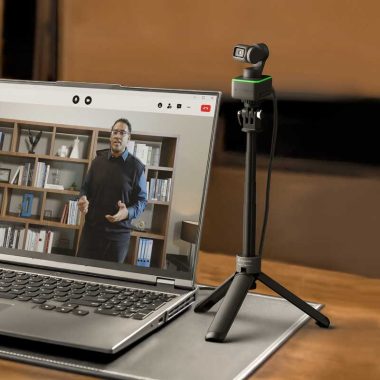
The Insta360 Link camera has touch control capabilities, which are found near the base of the device, as was previously described. In order to connect to your computer, there is a USB-C port on the back of the base. A cleanly constructed LED indication light is also there, making it less invasive than the bright red dots we see in most webcams. The Insta360 Link 4K is really simple to set up. It should be operational after just plugging it into your pc. I prefer to use the Link 4K with a tripod, which is made feasible by the built-in thread at the bottom of the camera base, even if it does have a built-in clip for mounting to a desktop monitor. Even though it is a plug-and-play device, you may use it more extensively by installing the Link controller software from Insta360, which is accessible on both Microsoft Windows and Mac computers. This method allows you a lot of control over the camera, therefore I advise taking it.
The desktop application is simple to use and provides a brief instruction on how to operate the camera motions. Creating the letter L symbol will activate zoom, while making the peace symbol will initiate whiteboard mode. Holding up your palm will enable the camera to automatically track your movement. The stickers that come with the package must be used in order to use whiteboard mode because they act as the camera’s tracking mechanism.Although you’ll require specialized attachments to hold the camera in a specific position, the camera also has other settings that can be used.
The image and video quality of the camera was another thing that I found to be impressive. The colors in the preview aren’t washed-out, unlike on the lot of other webcams out there, and it was quite clear with barely any grain. In fact, Insta360 Link camera is perhaps the highest quality I’ve seen to date in terms of webcams. If you’re not happy with the default image color, you can adjust the visual quality of your footage using a number of sophisticated settings in the desktop app. You may adjust everything to your preferences, including contrast, saturation, sharpness, white balance, and HDR. You may choose between manual and autofocus on the Link 4K.
When compared to the Lumina A.I. 4K webcam or Dell’s UltraSharp 4K camera, the Insta360 Link isn’t as small or as minimalist in its appearance due to its concentration on advanced technologies, such as a three-axis gimbal. Even yet, it fits a lot of functionality into a chassis that is only 2.71 x 1.61 x 1.77 inches in size (69mm x 41mm x 45mm). In addition, although employing a lot more plastic than the all-metal shell of the Lumina AI camera, the Insta360 Link camera weighs only 106 grams and feels powerful.
The Link Controller program offers fine-grained control over functions like image setup, AI zoom, manual focusing, HDR, and other options for more experienced users. For instance, you can adjust any of the settings for exposure, white balance, brightness, contrast, saturation, and sharpness to your preference or you can completely rely on the software’s sophisticated AI capabilities. We had no issues with the automated AI adjustments in our test under LED light bulbs and in harsher lighting while working in front of a bright window. As we do, users can activate HDR mode when working in less than ideal lighting settings, although these features are not enabled at 4K resolution or 60 frames per second.
There isn’t anything to criticize about the Insta360’s software or functionality because it is a well-made camera. To obtain the greatest results, you should upgrade both the Link Controller’s software and the camera’s firmware whenever new versions become available. A short firmware update on the camera helped to increase image quality and HDR processing right out of the box.
Having said that, we wished the Insta360 Link came with more protective accessories out of the box considering it is such a high-end camera.
The Insta360 Link also features excellent image quality, efficient tracking, and excellent audio capture, all of which are basic requirements for a webcam. The Link performs well because it combines sophisticated software with cutting-edge hardware. Insta360’s Link faces competition from not only rival 1080p and 4K webcams, but also from very nimble built-in cameras that come standard on most laptops and some all-in-one desktops. Numerous of these technologies, including the webcams used on Apple’s iPad and MacBook Pro, have artificial intelligence built in to help track and frame moving subjects. The best thing about built-in cams is that no additional hardware or money is needed to use them.
Additionally, the desktop app allows you to switch between 720p, 1080p, and 4K resolutions, which is a really useful feature and demonstrates the webcam’s extensive range of customizability choices. One thing to keep in mind is that the Insta360 Link does cost a little more than similar cameras on the market. The base package, which comes with the camera and the usual set of accessories, costs around $299. However, if you spend a little more, you can also purchase the kit with a tripod for about 328 $. Although Insta360 Link is not the cheapest webcam available, you do get a lot of functionality for the price. You get a lot for your money with the Link 4K because of the variety of video settings, ease of usage, and superb build quality. These features are uncommon in contemporary webcams, but they are sufficient to set it apart from the rivals. Video: YouTube/Insta360
Video Resolution – 4K@24/25/30fps, 1080p@24/25/30/50/60fps, 720p@24/25/30/50/60fps
Video Coding Format – H.264 (all resolutions and frame rates), MJPEG (4K@24/25fps, 1080p all frame rates, 720p all frame rates)
Exposure Compensation ±3 EV
ISO 100-3200
Shutter Speed – 1/8000-1/30s
White Balance – 2000-10000K
Aperture – F1.8
35mm Equivalent Focal Length – 26mm
Fixed FOV – DFOV 79.5°, HFOV 67°
Modes – Portrait, Whiteboard, DeskView, Overhead
Digital Zoom – Up to 4x
Autofocus – Supported at a distance of 10cm (4in) to ∞
HDR – Supported for 1080p@24/25/30fps and 720p@24/25/30fps
AI Tracking – Supports with and without AI zoom
Audio – Dual noise-canceling microphones
UVC 1.1
UAC 1.0
Button – 1x Touch Key
Connectivity – Via USB-C to USB-C cable (USB 2.0) or Type-C to Type-A adapter
Battery – None
Power Consumption – 5V/1A
Mounting Options – 1/4″ mounting point for tripod mounting and a built-in clip for computer screen mounting
Dimensions – 63×35×45mm
Weight – 106g (3.73oz)
System Requirements – Operating System: Windows 8 or later (Windows 8.1 or higher required for 4K); macOS 10.13 or later. RAM: 2GB RAM or more for 1080p or higher; 1GB for 720p.
Operating Temperature – 0°C to 40℃ (32°F to 104°F)
WiFi 7, the newest generation of wireless technology, has been introduced for the first time by Intel and Broadcom. Over-the-air speeds of more than 5Gbps were reached by the companies using an Intel-powered laptop and a Broadcom access point. With the inclusion of the wider 320MHz channels, the most recent iteration of wireless communications technology, which is based on the 802.11be standards, can reach faster over-the-air speeds than earlier generations. These are made accessible in the unlicensed 6GHz band.
During a demonstration of the technology, Intel stated that WiFi 7 also promised network capacity five times more than that made feasible by WiFi 6E, 100 times better “worst case latency,” and 15 times better latency for augmented and virtual reality devices.
photo: Freepik
WiFi 7 also incorporates 4K QAM modulation, enabling simultaneous connections across many bands and more effective use of the device’s available spectrum thanks to “multi-link operation” and enhanced channel utilisation. All of this allows for more flexibility in how the spectrum and bandwidth are used, which will be advantageous for a range of use cases. Wi-Fi 7’s deterministic operation, according to an Intel statement, “enables new product classes while supporting huge numbers of connected devices in the home or office, including augmented and virtual reality, ultra-high-definition 16K media streaming, and super-responsive and efficient gaming.”
When will WiFi 7 be available? Even if the first products with WiFi 7 built-in won’t be available until the end of the year, Carlos Cordeiro, wireless CTO for Intel estimates that it won’t be until 2024 before the technology is included in equipment used in businesses.
According to Phil Solis, research director for connectivity at analyst firm IDC, “WiFi 7 is the most potent and capable WiFi protocol ever and will allow WiFi to continue to service the most demanding applications in the consumer and vertical industries with the highest level of determinism yet.” Although widespread implementation of the technology is at least a year away, it will enable household customers to benefit fully from expanding multi-gigabit internet options and better network management for enterprise clients.
The demonstration, according to Vijay Nagarajan, vice president of Broadcom’s wireless connectivity division, shows that the ecosystem is prepared for WiFi 7 and will “provide tremendous capacity” in addition to “blazing fast speeds to extend gigabit broadband.” A subsequent demonstration will highlight the multi-resource unit puncturing and multi-link operation that provide lower latency and improved dependability. The initial demonstration revealed 320 MHz channels and 4K QAM modulation enabling for multi-gig WiFi speeds.
The most secure home Wi-Fi router must offer excellent network security in addition to high-speed data transmissions and extensive coverage. Home router security must be given high importance when thinking about the home router because your Wi-Fi station serves as the gateway for all connected devices to access the internet.
All of your internet-connected gadgets are exposed if your router has malicious software on it.
The necessity of taking network security more seriously has been brought home by a recent cyberthreat. Malware that is able to control your online traffic can target base stations from a particularly well-known router manufacturer. It could be used by attackers to steal your login information and empty your bank accounts. They could even open fake versions of the email service you use to view your messages and steal your password.
How therefore can we maintain the security of our home router from such threats?
1. Frequently update firmware
Get your IP address, a string of numbers you must enter into a web browser to access the router’s online dashboard, from the instruction manual for your router. Keep the IP address in a secure location. You can check for and install the most recent firmware version by clicking the firmware settings link in the router’s web dashboard. If a new update is available, choose to install it and reboot the router. Repeat this process every six months. Just like you should maintain operating systems updated on your personal computer, make sure your Wi-Fi station is always using the most recent version of its “firmware,” or software system.
photo: Pixabay
2. Create a special username and password
Manufacturers want you to modify the weak default password that many Wi-Fi stations come with. With a weak login and password, anyone within your router’s range may access it and modify its settings, possibly exposing it to the wider community. Check your security settings and update your username and password to something secure and original. Security experts advise establishing lengthy, complex passwords with additional digits, unusual characters, and incomprehensible sentences. In the same location where you recorded your IP address, keep your new password.
3. After several years, change your router
Even if your router still seems to be operating normally, it has reached the end of its useful life once the manufacturers discontinue providing firmware updates, leaving it open to potential cyberthreats in the future. This will most likely occur every 3 to 5 years. It is essential to upgrade to newer hardware at that point. If there haven’t been any new firmware updates in the last year, the router has likely been taken off the market, and it’s time to update your router. Check your manufacturer’s website for its firmware releases. Automatic updates are a feature included in many recent Wi-Fi systems.
Disable UPnP UPnP is a protocol that allows LAN-connected devices to break the router’s firewall. This makes these devices accessible to the entire Internet, where they may be attacked if they are weak points. Actually, port forwarding is enabled via UPnP without the router owner even being aware of what port forwarding is. Disabling UPnP makes you safer. You can log in to the router to see if any port forwarding is being done. The safe and secure condition is when no ports are forwarded. Nevertheless, there is a potential that disabling UPnP will interfere with a network communication that a device on your network, most likely an IoT device, relies on. This is why it is turned on by default on all consumer routers—it will reduce the number of calls to technical assistance.
Any router’s security can be significantly increased by implementing the configuration changes in this relatively small list:
– The router access password should be changed. Anything other than the default should be OK, but avoid using dictionary terms. – Even if it seems odd, if your Wi-Fi network(s) are using the default password, change it. The minimum length for a Wi-Fi password is 16 characters. – Change your WiFi network name (SSID) if it is the default. Avoid including your name in the names you choose for your networks. – WPA2 (with AES, not TKIP) or WPA3 or both should be used for wi-fi encryption. – Disable WPS – Disable UPnP
– Always use a password-protected guest network, not just for visitors but also for Internet of Things (IoT) devices. – Since Remote Administration is so extremely risky, take the time to confirm that it is disabled if the router has a web interface. Disabling remote access to the router is untested territory if it is controlled by a mobile app and a cloud service. – Technically speaking, port forwarding is like opening a door (TCP/IP port). Make sure there is no port forwarding by checking around the router configuration. There is a slight possibility that something on your network requires a port to be forwarded, but every port that is forwarded poses a security risk.
– Keep an eye out for brand new firmware updates. You will eventually go longer than a year without any updates. When that happens, a new router is required.
Your home’s digital infrastructure depends on having reliable, fast Wi-Fi, and your router is at its most safe when equipped with robust security measures. A few simple precautions taken regularly can go a long way toward ensuring a secure online experience for the whole family.